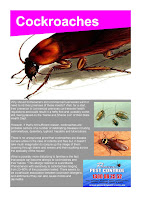
Termites are cockroaches now? How did that happen?
Back
in the days of my TAFE course in urban pest management we were taught all about
the various orders of insects within Class Insecta. These included Hymenoptera
(ants, bees and wasps), Siphonaptera (fleas), Thysanura (silverfish), Diptera
(flies), Blattodea (cockroaches) and Isoptera (termites).
Insects
are all members of the Class Insecta and each order within that class groups
the most closely related insect types. It was often said that termites and
praying mantis were closely related to cockroaches although this was not taken
too seriously in some circles. However, it turns out that the family tree of
Class Insecta has had to be re-written. Studies comparing various cockroach
groups with various termite groups have reached the conclusion that termites
are not their own order, but are intact. Social cockroaches.
One study from the
Natural History Museum in London (Inward et al. (200T) Biology Letters 3. 331-
33.5) carried out molecular phylogenetic analyses on a range of insects from
mantids to cockroaches and termites and came to the conclusion that termites no
longer merited their own order. Basically an analysis of specific gene loci
found that there is sufficient commonality of genes to indicate that termites
belong within the order Blattodea.
Work published this year by mostly
Australian researchers, Stephen Cameron
from QUT, NateLo from Sydney University. And Theo
Evans from National University of Singapore, has confirmed this result
(Cameron et al. (2012) Molecular Phylogenetic and Evolution 65, 15:1-173).
Thus the relationship of termites as a special kind of social cockroaches
exactly matches that of ants as a special kind of wasp.
The
closest relatives to the termites are the wood roaches (Cryptocercus), which
makes sense in that they have a similar diet unlike the other cockroach
species. Much of the early speculation as far back as the 1930s about
cockroaches and termites being related came from the fact that Cryptocercas and
early termites (our very own Mastoterrnes darwirtiensis) shared several groups
of symbiotic gut protozoa.
So they used the same sorts cal protozoa to break
down wood in their gut, and bacteria in their fat-bodies (which function like
livers do in humans) to recycle waste nitrogen. Cryptoceras also exhibits some
sub social behavior caring for its young, unlike other cockroaches. Primary
reproductive of Mastotermes also have many physical similarities to sub-adult Cryptocercus.
This resemblance reflects a larger
evolutionary trend: termites retain ever more juvenile characteristics in more
evolved groups. (And dogs are like young wolves.)
The
evidence suggested that the order Isoptera should be downgraded to the family
Termitidae. This caused plenty of angst as the seven existing termite families
were already well known and the name Terrnitidae was already in use.
Consequently, the possible downgrading of Isoptera caused some consternation in
the taxonomic world with some believing Isoptera should remain an order despite
the new evidence.
The
fate of 'Order Isoptera' has been partly spared from the chopping block.
However, it has been demoted lo an "epilamily" and renamed
'Termitidae" which sits joist above the family level to cover all the
termite families.
Therefore all the termite families we know such as Termitidae
(including Nasutitermes), Rhinotermitidae (Coptotermes, Schedorhinotermes,
Heterotermes), Kalotermitidae (Cryptotermes) and Mastotermitidae (Masotermes)
remain as they were. The American Entomological Society, the largest insect
society in the world does not yet recognize this change. However the Royal
Entomological Society (UK).
The Australian Entomological Society and various
others are more accepting. What does this mean for the pest control industry?
Well not much as it happens. The termites don't know they are now cockroaches
so they are unlikely to change their behavior any time soon.
It is an
interesting story to educate clients with but no one would want to give the
impression that a termite infestation is equivalent to a cockroach infestation,
it makes for an interesting topic for conversation among PCOs though. Just saw
a place that was being destroyed by cockroaches!"
With
thanks to Dr Theo Evans for his additional input.
Termites can nest almost anywhere in New South Wales.
They are mostly single site nesters, however they can
build secondary nests within buildings that may survive for years isolated from
the ground. Termites commonly establish nests within the root crown of a
tree, in old sleepers used for garden bed edges, in timber garden posts and in
timber piers under houses and sheds.
There
is often no visible external evidence of nests, I find termite nests mainly in
the bases of trees and timber house piers, but nests can also be located high
up in tree trunks many metres off the ground. Old timber railway sleepers are
also very vulnerable.
Termites put their nests under the bottom of the sleeper,
in the ground. If they are used for retaining walls they will nest behind the
sleepers in the soil. The drilling of these sleepers usually does not reveal
termites and the only way to cheek them is to remove each sleeper and look for
a nest. From their nests in trees, the termites make subterranean tunnels
extending over 50m to reach limber in buildings.
Often such infestations are
not detected until extensive damage has been done, when there is an infestation
in a house or shed firstly look for any trees or timber fence posts and then
inspect them for any mudding or flight holes that indicate termite activity. I
also check tree stumps that are situated within about 50-60m of the affected
building, then commence a drilling program to test drill any trees, stumps or
posts.
Proven Pest Control use a machine called an Atom borer that affixes to a chainsaw
motor and then use 16rnm or 18mm drill bits to drill. I have two bits, one 40cm long and
another about 60-80cm long. Depending on the size of the tree, I drill one to
three holes at a 45-degree angle down past the centre. If I feel a hollow in
the tree I leave it for about 5-10 minutes and then check for active termites
using either a temperature probe, or a piece of grass which the soldier
termites will cling to.
If there is no activity, the holes are left open for
1-3 days and then checked. I often find the termites have totally mudded up the
hole giving me an indication that there is a nest somewhere in the tree. Often
the nest will be either below the drilled holes or well above, and the early
plugging of the holes will allow the termites to continue undetected.
Termites do not like air entering the tree and will usually travel either down or up
from the nest and mud the hole out. This indicates that there is a nest
somewhere in the tree, post or stump- After this time the hole can be sealed
using gap filler or commercially available plastic plugs. I often recommend
that the tree and stump be fully removed if the nest is large and a lot of the
centre of the tree trunk has been eaten out to accommodate the termite nest.
If
the owner wants the tree preserved then I obtain a signed authority to pump
termiticide into the tree trunk advising the owner that the tree may collapse
after the nest is treated, or that the tree may also die due to the termite
damage.
Brought to you by Proven Pest Control. Serving New South Wales as a guaranteed, trustworthy business and will eliminate your pests of concern
at an affordable cost.
Alex here just thought we'd cross over to live to a customer's premises. Now we had a phone call couple of days from a very distraught customer, who had discovered termites on that property or termite damage.
Now they had another company come out around about three months ago to get rid of these termites, however they've now discovered that the termites having indeed moved to another part of the house and when we go in to look at the treatment done we could see why they've moved to another part of the house, so I'm going to show you some of the damage that's been done and what the customer noticed.
First of all when they came in and saw the termite damage so you can see here the damage or the mudding has done to be packed into the wall cavity there. Now that was once flush just like it is there and now the mudding’s pushed it out, the customer hadn't been out is he out here for about three or four months and this is the first time they'd actually seen this they will go around see if we can see inside the actual damaged area so you could see all this termite mudding.
Here now this is a storage cupboard underneath a set of stairs goes right up to the top there. The hot water system, was leaking down here which is one of the conducive, it's a conducive environment for termites the moisture is what drawn them to this little area here. You can see in there some mud shelter tubing happening in there.
The company that came out prior to us dusted this particular area and you can see you know you may not be able to see but in there they've packed in all this dust which is the incorrect way to actually treat the termites because you're just blocking up all the tubing there.
That's way too much dust; what they've done is they've tried to pump too much of the chemical into the into the tubes all at once instead of doing it over a period of two or three days. They’ve tried to do it in about 10 minutes and that's the wrong way to do things so all they've done is scare the termites off and they've moved into another part of the house.
What's happened is the termites themselves they've moved out of this little cupboard here and they've moved into the kitchen flooring in the subfloor now when they weren't there before so now not only do we need to treat that particular area under the kitchen subfloor, but now we're going to have to do a full chemical barrier which should always be done as part of any treatment either a chemical barrier or a termite monitoring station setup.
That really depends on your soil, slope of the ground and certainly a few other more things like safety issues between doing a chemical barrier and your monitoring stations. Obviously if you're on earth on a steep slope you're not going to be able to do a chemical barrier because after chemical, first rain is just going to rush down that hill. There have been cases where there's been a creek at the at the bottom of the hill and the chemical was actually runoff into that creek and the pest control operator has copped quite a nasty little fine from the EPA for poisoning waterways, so that's when we would consider using termite monitoring stations.
What I'm going to do now is I'm going to show you some of the conducive conditions that probably led to these termites entering the home particularly this this home and a few conducive conditions you might find throughout your property. So the first thing we notice is that the hot water system, it was obviously dripping against the wall here, the termites were attracted by the moisture and that's what's led them into the cupboard which is on the other side of that wall.
They've added a pipe here which still isn't good enough because it's not that far away from the slab itself all that moisture is just one big attractant to termites coupled with things like pieces of timber left on the ground all over the place. You've got quite a few trees here and shrubs but also, we've got leaking roofs which has led to timber rot.
Timber in direct contact with the soil; these are all things that will attract termites. Termites don't know the difference between a tree and your house they have absolutely no idea difference between the difference of those two, so when you have things like garden beds up against your house, you are inviting them into your house.
It’s sort of leaving bread crumbs for them to follow from your house, so they might start here in the garden they'll come along the timber here and then they'll start to explore a little bit further out here. As you can see here we've got a leaking air conditioning unit which is dropping moisture straight in there, now on the other side of this wall is a large termite nest.
Some of those some of some things I used to do to explain it to the customers as simply as possible is that termite say your natural foragers in the bush, they find a dead or decaying trees and timber debris and they break it down scavenging those and breaking it down. In your home or in your garden, all your man-made objects, they don't know the difference between the two. You may have your landscaping timbers here they don't know that that's the landscaping too, but they think that's just a fallen tree branch so they're going to start attacking that.
Then they're going to scout a little bit further along and look for your moisture thinking that it's a creek, or it's sort of a mulch vegetation. Which they can then attack and then that obviously leads them into your garden beds and they come across your mulch, which to them is just bark and they're thinking: “well if there's bark around then there's a tree.”
They don't know the difference between a tree and your house so they'll get into your house and they'll start thinking, well this is the tree it's quite a bit of timber here let's set up camp here and that's when you start getting into problems.
It’s always important trying keep your gardens free of debris mulch and stuff even-even in that how its raised up here, you can see it's raised above the weep holes in too much it's just going to come straight through this straight through the soil here and enter the weep holes on the other side.
Obviously all this sort of debris down here is no good, you're going to have timber here you probably kick this over and you'll find termites underneath. This is all attractants to them they don't know that this is all treated or painted Timbers they'll have a go at it anyway and if they don't like the taste of it they'll keep on searching and it's so close to the house they'll find your structural pine fairly easily.
Also stuff like this makes it really hard for a pest controller to inspect your property or your property properly so when you do have an inspection or you just get your basic pest spray done make sure you're trying give us enough room so we can actually see down the side. I mean we're not we're not supermen or anything which we don't have the x-ray vision or anything, you know it could possibly be Termites down there Redback spiders the whole lot.
So if we're spraying either food yet your spiders or we're doing your termite inspections it's absolutely no way we're going to be able to see any sort of issues down this sort of area, so it's always good to keep this these sorts of areas clear.
You can see up here you've got trees leading into the gutter in there no generally you won't probably get termites going up these little tiny branches and into you into your oozed it can happen but it's quite rare for that to happen but possums, rats, mice up climbing those trees and get straight into your gutters and into your roof voids.
Again, more moisture obviously coming into summer you're going to have all your mosquitoes in there. Mosquitoes isn't something that we can really treat effectively, you could do just as a good of a job with stuff from Bunnings. So save yourself a bit of money if you're only concerned about mosquitoes, get rid of all that standing water and get some stuff from Bunnings and do it yourself.
Really, it's not worth getting a pest controller out for just for mosquitoes everything else obviously yeah definitely spiders Redbacks, cockroaches, Termites always together get a qualified pest controller out to sort that out.
Now here's another issue, we've got leaking gutters. Again, during the winter, during the rain the gutters begin to leak create moisture down here in the garden beds and that's going to attract your Termites.
The Pest Control inspection service in Annandale is a great way to prevent future infestations, and it is a great way to identify additional services that the customer may need to keep their structure pest-free. Some of those additional services, such as the sealing of small cracks and crevices, should be included in your normal service offerings. But additional problems, such as moisture control, wildlife control and exclusion, are additional services that can be sold and provided to your customer. This is a great way for a pest management professional to become a “one-stop shop” for your customer, and prevent your competition from getting their feet in the door.
LEAVE NOTHING BUT FOOTPRINTS. Moving under homes to inspect the crawlspace, digging through the leaf litter in the gutters, or walking through the insulation in an attic, can be messy. In addition, the pest management professional may be required to drill into a concrete slab, cut holes or openings into walls, and even dig up landscaping to treat a structure. However, upon completion of these tasks, we should always be prepared to leave a customer’s home in the same condition, or better condition, than when we arrived.
Pest Control Technicians always should be prepared by carrying the necessary tools and equipment needed to keep the home clean and repair any damage they may have caused. This may include using crawl suits or coveralls when working in dirty areas and removing them prior to entering the home. Shoe covers are also a great way to protect a customer’s home from any debris that may be carried in on your shoes. It’s also a good practice to carry a garden rake to repair the landscaping, as well as a caulk gun, caulking and spackling to help fill any holes created during your treatment.
IMPROVING CUSTOMER COMMUNICATION. Customers who cancel service often report that one of the reasons for their cancellation is they “didn’t know what was done.” This lack of communication with the customer is a big deal, and one that can be easily fixed. As a pest management professional, it is important to communicate with your customer, even when they are not home. Any time you leave a customer’s location you should document at least three things. The first is what you did during today’s service. This lets the customer know exactly what you did, and it is especially important if they are not home to witness your service. You don’t have to write a novel, but a couple of sentences highlighting areas that you inspected and areas that you treated.
The second piece of information that you should communicate is what you saw during the service visit. This is a great opportunity to tell the customer about any sanitation or structural issues that you may have observed during your service. You can also let the customer know if there was any pest activity and how you treated those infestations. Develop a partnership with your customer in creating a successful pest management program.
Lastly, you should always let the customer know what to expect following your service. This may be a simple note detailing that they may see a few bugs for a couple of days following your treatment, or it may simply be a note letting them know when you will be returning for a follow-up service or next service. Let the customer know that you are there to do more than “kill the bugs.”
Invasive pests are a huge threat to the economy — and keeping them out of Australia is no easy task. Here’s what you can do to help.
Invasive species are serious trouble, causing an estimated $120 billion in damage each year, according to the Australian Department of Agriculture.
Keeping alien insects, animals, plants, seeds and pathogens from entering through the country’s 300-plus ports is the job of Australian Customs and Border Protection (CBP). Every day, more than 2,300 specialists inspect shipping containers, bulk produce, wood packing material and passenger baggage delivered by airplanes, ships, trains, trucks and international mail.
Last year, CBP officers conducted 22,638,509 passenger inspections and 705,510 cargo inspections. They intercepted 155,247 pests — 66,857 of these were reportable or of high concern.
A CONSTANT BATTLE. CBP officers do an impossible job, said Bob Vander Meer, research leader at the USDA’s Agricultural Research Service in Gainesville, Fla. “It’s amazing we don’t have more invasive pest species in Australia. already,” he said. The “downward pressure” is incredible given the high level of international trade and travel, said University of Georgia Entomologist Dan Suiter. Nearly 25 million shipping containers arrive at Australian maritime ports and land borders each year, reports CBP.
High on the agency’s most-wanted list are forest pests like the Asian gypsy moth, emerald ash borer and Asian long-horned beetle, as well as the spotted lantern fly and Khapra beetle, a grain pest. The Khapra beetle is “impervious to fumigation and pesticides” and can remain dormant for a long time, said CBP Public Affairs Officer Stephen Sapp. If it were to “gain some sort of a foothold here in Australia, you’re talking about a massive economic impact,” as it essentially would shut down Australian grain exports, he explained.
Officers of CBP’s Atlanta Field Office, which covers Georgia, the Carolinas and parts of Virginia, have intercepted Khapra beetles 106 times in the past three years, said Raina Dodson, agriculture operations manager. “Most of those were in passenger baggage,” but they’re also found in bulk cargo, she said.
From January 2012 to 2015, the Atlanta Field Office intercepted 30,633 pests and diseases, Dodson said. These included Africanized bees, subterranean and drywood termites, 95 cases involving ants of “highest concern,” and other animals, noxious weed seeds, plants and fungi/diseases, said Dodson.
THE SCIENCE OF INSPECTION. Knowing what to inspect is “a science in and of itself” and is based on “a risk assessment of what’s coming in,” said Dodson. The “data-driven” analysis considers CBP’s history of interceptions, shippers’ logbooks and manifests, time of year, pest biology and high-risk commodities, she explained. CBP tracks national holidays so it knows when to expect spikes in passengers trying to bring in food products. It also monitors outbreaks in other countries, which can “literally force overnight changes in what can come in (to the U.S.) and what cannot,” said Dodson.
CBP officers can’t inspect everything, but “they are smart about it; they know who the troublemakers are in the world,” said Suiter. The agency knows, for instance, where the Khapra beetle is most common, and who puts fraudulent stamps on wood pallets, which must be treated for wood borers, he explained. CBP canines help inspect handbags and backpacks of low-risk passengers at airports.
When pests of concern are found by CBP officers and confirmed by USDA entomologists as requiring action, cargo is isolated and quarantined, fumigated or shipped back. Ships found to have Asian gypsy moths or egg clusters are sent miles offshore to be cleaned and then are re-inspected.
CBP works with shipping companies and airlines to develop best practices and trains partners to ensure compliance. “At the end of the day, it has got to be a collaborative effort between all of us,” said Dodson. People ordering shipments should demand a clean supply chain; if shippers cleaned up containers many problems would be eliminated, she said. Her officers once vacuumed 34 pounds of seeds adhered to the outside of a shipping container. Khapra beetles are found in dirt on the floor of containers because shippers don’t bother to sweep them out in their home country, she said.
YOUR ROLE. Every port has a pest risk committee of state, federal, university and business stakeholders. Dodson encouraged pest management professionals to take part in these meetings. “We’re all better if we leverage our skills and our abilities and our resources,” she said.
Because PMPs are “on the front lines,” it’s “extremely important” to keep your eyes open to pests that act or look differently, said Vander Meer. PMPs “see things before we would even know about them. That’s part of the major way in which we make discoveries about new ant species,” he said.
The first reports of kudzu bugs came from three pest control companies in northeast Atlanta, Suiter said. “If you see something that’s out of the ordinary, let your state entomology department know about it,” he said.
Mike Rust, entomologist at the University of California-Riverside, suggested PMPs carry a vial of alcohol, forceps and a paintbrush to collect samples for identification. Do this the first time instinct tells you a pest is different, not the sixth. Proper identification will help you control a pest faster; it also could prevent an invasive species from taking hold.
These highly sensitive accounts require specialized pest management expertise.
Zoos and aquariums are particularly challenging because they typically have an abundance of food, water, harborage and ideal temperatures for pest development. Since a zoo can be a “pest paradise,” pest management is a critical component of protecting its animals and visitors from injurious pests. Despite the fact that pests may be harmful, technicians also must be attentive to protecting the zoo animals from the pest management tools used in service. Some of the animals may be endangered or protected species, which can be of added concern.
Certain animals, such as primates, may be extremely talented at accessing products placed for pest management. Small animals with low body weights (birds, small rodents, reptiles, etc.) may be more susceptible to pesticide products, and because of their small size, they may be capable of accessing pesticides even when placed in containerized stations. Even non-chemical pest control methods, such as snap traps, can pose a hazard to some zoo animals.
It is extremely important that the PMP work closely with zoo staff in determining acceptable pest management strategies for each area and target pest. A written plan must be developed as part of the contract process and agreed upon by zoo veterinarians prior to the start of service. Animal curators should be consulted regarding material placement and capabilities of animals housed in each covered treatment site. A strong knowledge of “least toxic” tools, types of pests common in zoos and creativity in pest management solutions are all required skills of PMPs working in zoos.
FINDING PESTS IN ZOOS. Zoos provide numerous resources for pests. In satisfying the survival needs of the zoo animals, the zoo environment also provides for pest survival and, often, chronic infestation. Tropical animals, for example, require environments with high temperatures and high humidity, which are ideal environmental conditions for pests like German cockroaches. In this article, we will deal with the conditions that encourage pests and other special challenges relating to the servicing of zoos.
Water. Water sources are abundant in zoos and aquariums, and they are possibly the most difficult resource to reduce as part of an Integrated Pest Management strategy. Water may be present as part of an aquatic animal habitat or may be present for animals to drink, and it may be used as part of public exhibits for aesthetics. Many animal displays will include plants as well as animals, and the plants must be watered. Water in moats or man-made streams may be used as barriers to keep animals within a particular area while maintaining the appeal of a “natural” setting.
In aquariums, moisture and high humidity can be issues in the behind-the-scene areas where tank access is provided, and contribute to pest problems. Although it may be difficult to reduce water or moisture available to pests in these environments, it is important to be aware of the impact that this resource can have on pest populations. Inspect and monitor these areas carefully, and always look for ways to reduce the potential for pest access to moisture.
Water also is an essential component in keeping zoo exhibit and animal-holding areas clean. Large quantities of water may be used to wash surfaces to help remove food and animal wastes. Over time, power washing can damage walls and leave organic debris and moisture in cracks and crevices where it may remain for long periods of time. Technicians should discuss options for reducing water availability and drying of any standing water. Fans may be an option to reduce moisture in animal-holding areas, and floor and wall surfaces should be designed to accommodate the heavy amounts of water used. Recommendations should be made for sealing areas damaged or deteriorated by water.
Food. Because zoos have a wide variety of animals on site, the foods stored and used at the facility are just as varied. Examples of foods typically prepared at zoos for animals include crickets and other insects, fruits, vegetables, pelletized feeds and grains, and meats. In addition, a wide array of food choices are prepared and served to visitors and staff at restaurants and concession stands.
Food may be left out 24/7 for finicky zoo animals. However, if possible, food should be placed out only during regular feeding times. Food never should be left out in exhibit areas in which animals are moved to a holding area at night. If food dishes must be left out for any reason, encourage the zoo staff to look at ways of modifying feeding dishes to discourage pest access while allowing exhibit animals to feed. For example, placing dishes on specially designed pedestals with feeding platforms can be effective in discouraging rodents in aviaries. Repellents or compounds which make surfaces slick should be explored to keep ants out of feeding dishes.
In food storage areas, all stored feeds and foods should be kept in sealed containers. All food should be inspected for signs of pests before it is accepted at the point of delivery, since stored product pests can make their way into a site from the food distribution warehouse. The zoo staff should incorporate a first-in, first-out (FIFO) system of stock rotation to keep storage or use of old/older products to a minimum. Young zoo animals or animals on loan may have different dietary requirements, and when a food is no longer needed, it should be discarded rather than left in storage.
Food wastes also should be properly handled. All exterior garbage receptacles should have closed lids—preferably self-closing — and refuse containers should be resistant to pest access.
Shelter. Pest harborage may be found in everything from the decorative wall coverings in public areas to behind-the-scenes animal housing. To enhance the zoo experience for visitors, exhibits are often developed with native habitat themes. The materials used in construction of these displays typically involve natural items like wood, rock, plants and soil. These materials provide numerous harborage sites for various pests.
Atrium areas with soil, rocks and plants can be ideal habitats for ants. Layered bamboo panels or wooden boards on walls or walkways can provide numerous cracks and crevices for cockroaches to harbor. Gunite is another common construction material found in zoos and aquariums. This material is used to create the look of rocks using cement and wire. Typically, there are numerous cracks and crevices in the rock design and voids behind the rock. Pests like cockroaches, rodents and ants can easily take up harborage in the cracks and voids of gunite.
ARTICLE CONTINUES AFTER ADVERTISEMENT
Non-public areas can have con-struction-design issues as well. Hollow-block concrete walls are a common construction material that can provide voids for pests. Cage supports may be hollow metal or wood, providing voids or preferred substrates for pests like German cockroaches.
Zoos can be subject to some unique pest pressures from incoming materials used in exhibits. Pests may be brought into zoo buildings on plants, wooden branches and other items used as accessories or animal enrichment in exhibits. Zoos have a quarantine procedure for new animals, but they rarely have the facilities for the quarantine of plants. Thorough inspections of all items coming into the zoo are required to help prevent pest entry.
Pests like red imported fire ants, Caribbean crazy ants and ghost ants have made their way into zoos on horticultural nursery stock. Other examples of pests imported into zoo and aquarium buildings on landscaping materials include wood-boring beetles, carpenter ants, fire ants, ghost ants and ornamental plant pests like scales and aphids that may then support ant development and survival.
Warmth. Follow the warmth when looking for pests at zoos. Indoor aviaries and other buildings that house tropical animals will have temperatures that are attractive to pests, such as German cockroaches and Pharaoh ants. Check areas around lights in aquariums and zoo exhibits for pests, since lights can provide added warmth for pest development.
Location. Zoos often are located in park areas where pressures from animals in the natural setting may provide a constant influx of new pests. Wildlife such as raccoons, foxes, feral cats, dogs and even deer may enter zoos. In addition to concerns of depredation of zoo animals by wild carnivores, many of these animals can spread diseases such as toxoplasmosis, rabies, chronic wasting disease and parvovirus. These animals also can spread parasites. Urban bird pests, such as pigeons and sparrows, can spread avian diseases. Commensal rodents can spread a variety of diseases, such as leptospirosis and salmonellosis, in addition to contaminating and feeding on zoo animal feed and food.
STAFF CONCERNS. There are special considerations regarding the sensitivity of zoo staff to pest management measures. Staff take the guardianship of animals very seriously and do not want to do anything to compromise the safety and health of these animals. Keepers may be reluctant to allow certain treatment procedures because of the risks they could pose to the animals.
It is important to develop a strong communication program with zoo staff to build a trusting relationship; establishing thresholds of acceptable pest population sizes also is useful. The zoo staff may elect to tolerate certain numbers of nuisance pests in certain areas rather than implement control. Determining tolerance levels and thresholds can help accommodate the zookeeper’s concerns regarding unnecessary treatments.
Keepers also may be sensitive to the humane treatment of pests during the control process. Some zoos may restrict the use of tools like sticky boards due to humaneness of kill. For this reason, it is important to discuss the use of different types of traps prior to the start of the service program.
SAFETY COMES FIRST. The PMP may be required to undergo certain medical testing or vaccinations before servicing a zoo. These requirements should be discussed with zoo administration prior to the start of service. Tuberculosis testing is a common requirement, but there may be others. This is for the protection of the animals as well as the technician.
In addition, the PMP may need to follow specific procedures to avoid carrying potentially harmful disease-causing organisms on his or her shoes or clothing from one exhibit area to another. The use of sanitizing foot baths as a means of containing the spread of disease on shoes is a common practice in zoos. Pest management staff must comply with zoo policies in this regard. As a general rule, practice good hygiene in handwashing and use of gloves when servicing.
The zoo also may have policies against the movement of equipment from one exhibit area to another to prevent diseases from being transported on the equipment. Guidelines regarding the movement of equipment from one exhibit space to another should be established prior to the start of service.
PMPs are present to protect zoo animals from pests, but in some instances they may need to protect themselves from zoo animals. It is important to be aware of the hazards in each of the service areas. In some zoos, a keeper will accompany the technician at all times. In other zoos, the technician may be escorted only when entering specific areas. It is important to know the proper safety procedures to follow in all animal areas, especially if servicing these without an escort.
Ask zookeepers about potential hazards in the areas you are to service. It is important to know the reach of animals when working in caged environments, and there may be certain noises or behaviors to avoid in certain exhibits. Even animals that seem relatively harmless may have quirks in their behavior which can cause problems. One example is that of a parrot that does not like to be talked to and bites his keepers when approached. Some animals may charge at exhibit enclosures when disturbed, so it is always best to ask what you can and can’t do in any given area to avoid adversely disrupting harmony in the exhibits.
IPM STRATEGIES. As with any pest management program, inspection should be the first step in the process. Inspections should be performed in all areas prior to the start of the contract and during each service. Inspections are needed to determine the types of pests, their locations, routes of entry and conditions favorable to pest development. It is equally important to determine the types of zoo animals present in infested areas and assess their capabilities to access pest control materials or placed devices, as well as any special sensitivity to pesticide products.
ARTICLE CONTINUES AFTER ADVERTISEMENT
Additional considerations would be public access and exposure. Pesticides should be applied in public areas only when the public is not present. All pesticide products used at the zoo must be cleared by the zoo veterinarian. Pesticide labels, material safety data sheets and manufacturers’ test results on non-target animals can be useful in the pesticide approval process. Ask pesticide manufacturers for additional supporting test data and research since there could be questions about secondary transfer of materials or species-specific sensitivities.
After the data is gathered, it is helpful to develop a materials authorization plan. This can then serve as a roadmap for service and should include all service areas and pest problems. The zoo veterinarian should sign-off on the plan prior to service.
MATERIALS AUTHORIZATION PLAN. After the initial site survey, inspection and monitoring will continue to be an important element of the service process. If a pest problem is discovered, non-chemical controls should be the first choice in solving the problem. Keep in mind that even non-chemical control solutions, such as snap traps, can be hazardous around certain animals, and special containers and procedures may be needed to prevent access to these devices in animal areas.
Wooden boxes with a series of baffles and restricted-sized openings can be used to prevent access to snap traps in bird or other areas. Specially designed pitfall traps may be used with lures, such as beer and bread, for pests like American cockroaches. Always ask zookeepers about animal capabilities to ensure the proposed methods will be safe. All equipment should be numbered and mapped for inspection and retrieval.
The second most common tool, after non-chemical controls, is the use of materials which are low in toxicity and volatility. Insecticide and rodenticide baits typically fall into this category. Again, specialized stations may be required to ensure that animals in exhibit areas cannot access the materials. Even pre-packaged containerized insecticide baits may not afford sufficient protection, and placing these stations inside other stations to create layers of protection may be advised.
All insecticides, including baits, must receive pre-approval; rodenticide baits will need special review. These products should not be used in areas where predatory animals may feed on rodents that have ingested the baits or where animals might be able to access the baits and feed directly on them. Certain rodenticides, like those containing the active ingredient cholecaliceferol, may be more acceptable in areas where birds are present, due to lower toxicity to this group of animals.
Insect growth regulators (IGRs), due to their relative safety around non-arthropods, may seem like a logical choice in zoos, but many zoos have arthropods in their displays. Make sure all arthropods on exhibit are known and taken into consideration before using IGRs. Certain IGRs can be highly volatile, and this volatility should be taken into consideration when determining treatment for non-arthropod areas adjacent to arthropod areas.
IGRs can be a useful tool for suppressing German cockroach populations where there are no arthropods on exhibit, and they also can be effective in combination with insecticide baits. IGRs also are effective for fly control in both interior and exterior areas. They may take time to work but can be an effective part of an integrated control strategy.
The last tier in the control program is the use of insecticidal dusts and sprays. These materials are typically used when other methods have failed to provide the desired control results. However, they may be used more frequently in non-animal areas like restaurants and commissaries. They also may be used when it is necessary to get quick control of a pest for animal or public safety reasons.
A typical use of dusts would be to control stinging bees or wasps, because the product is applied directly to the nests. All zoo animals should be cleared from the area prior to treatment. Dusts, like diatomaceous earth or boric acid, may be used for the control of pests in voids, such as cockroaches and other crawling insects. Care must be taken to ensure that dust-coated insects are not a risk to zoo animals that may feed on them.
Insecticidal sprays may be required to supplement other control efforts for certain pests, like ants or cockroaches. Non-repellent products may be needed to treat exterior areas and can be an effective strategy when ants are foraging outdoors and indoors. The use of low-pressures and more precise treatment-application strategies are advised whenever insecticide sprays are used. Consider removing equipment out of animal areas for treatment, then returning it once deposits have dried and equipment is cleaned.
APPLICABLE REGULATIONS. As with any commercial pesticide application, all federal, state and local pesticide regulations apply to zoos. In addition, there are requirements under USDA’s Animal Welfare Act that pertain to animal welfare and pest management.
SUMMARY. Good client communication is important in any pest management program, but especially so in sensitive facilities like zoos. Strong lines of communication between the pest management professional and zoo staff is essential in keeping the zoo animals, staff and visitors safe. It is also important for pest management professionals to know the required zoo safety rules to keep themselves protected from potentially hazardous animals. The communication process starts during the initial contract survey and builds from there throughout the duration of the program. Zoos can be one of the most challenging, interesting and rewarding sites that a PMP services. These facilities require sharp technical skills backed by solid communication.

 Insects
are all members of the Class Insecta and each order within that class groups
the most closely related insect types. It was often said that termites and
praying mantis were closely related to cockroaches although this was not taken
too seriously in some circles. However, it turns out that the family tree of
Class Insecta has had to be re-written. Studies comparing various cockroach
groups with various termite groups have reached the conclusion that termites
are not their own order, but are intact. Social cockroaches.
Insects
are all members of the Class Insecta and each order within that class groups
the most closely related insect types. It was often said that termites and
praying mantis were closely related to cockroaches although this was not taken
too seriously in some circles. However, it turns out that the family tree of
Class Insecta has had to be re-written. Studies comparing various cockroach
groups with various termite groups have reached the conclusion that termites
are not their own order, but are intact. Social cockroaches.  Consequently, the possible downgrading of Isoptera caused some consternation in
the taxonomic world with some believing Isoptera should remain an order despite
the new evidence.
Consequently, the possible downgrading of Isoptera caused some consternation in
the taxonomic world with some believing Isoptera should remain an order despite
the new evidence.